
My wife came into my office this morning, teary-eyed. She had come across an online feed showing a series of images of people in various places, holding up photographs taken in those same places at times past. One had a man holding up a picture of the Twin Towers in New York City before they were taken to the ground by terrorists. Another showed a room with a light beam landing on the floor with someone holding up a photo of their now-deceased dog, lying on the floor, basking in the sun. There were many other similar photos, and the presentation was well done and emotionally impactful. While I didn’t get teary-eyed, I will admit they were very touching, and I could understand why they would affect her the way they did.
It reminded me of something I’d thought about in the past. I wonder how much impact the advent of photography and, eventually, video has had on our brains and emotional well-being?
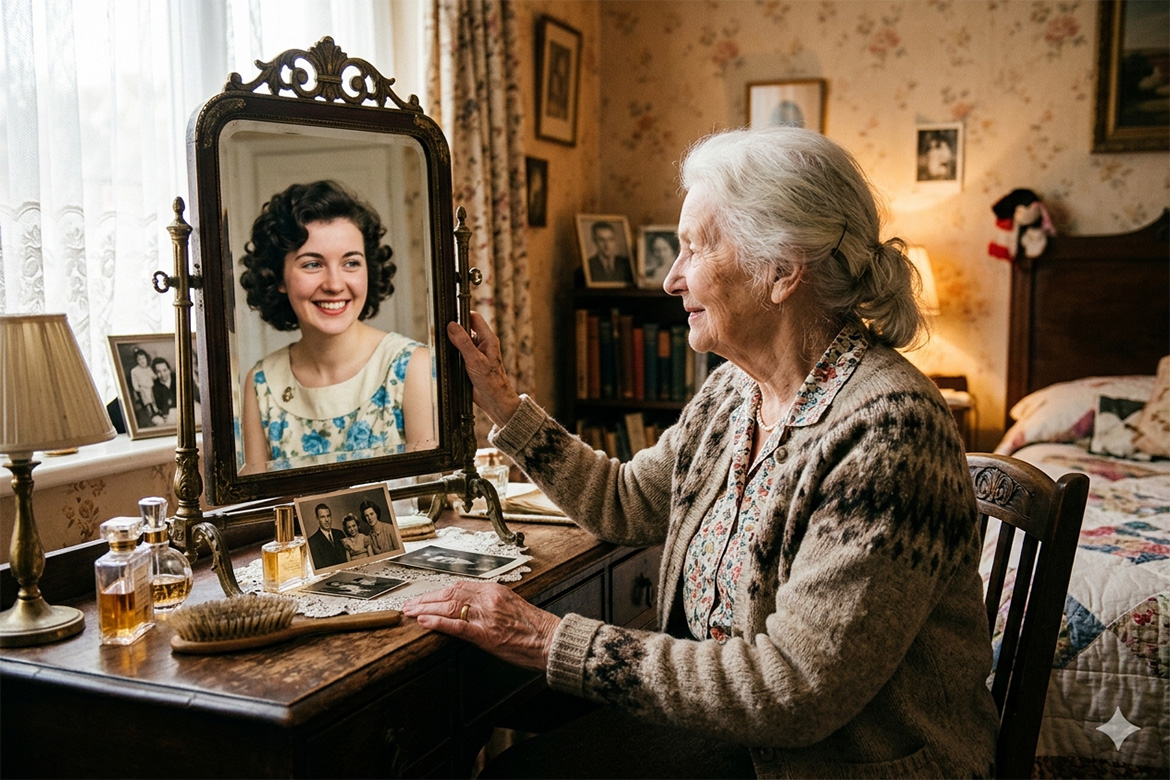
Before these things were invented, time was much more abstract. We knew that it was passing, since we saw the things around us changing and witnessed our friends and family growing older, but it was on a continuum, with subtle changes occurring, often with little notice, over a long period of time. With the advent of new technologies, we can now see those changes in stark, jarring detail. There was now a record of our lives as time marched forward. We could see ourselves age and be reminded of the people we once were, and of how our parents and grandparents, whom we always thought of as old, were once just like us. I’ve got to believe that this ability has profoundly changed us.
Going back even further, there was a time when we had no knowledge of what we looked like. Before the mirror was invented, unless you happened upon a still stream and got a glimpse of your distorted reflection, your appearance was a mystery to you. You could have been the most beautiful person to ever grace the planet or a hideous monster, but the only clue you had was given by the way others reacted to you. Just imagine going through life and never knowing what you looked like. Would that be good or bad?
Going forward, things are going to get even stranger. With the advent of AI and its ability to generate realistic images and videos, the reality of our past can now be fully distorted. People who didn’t exist will now exist. Events that didn’t happen will have taken place. Will future generations have any clue what the world was really like, or will their history be a fantasy generated by a computer?
There’s little doubt that all the technologies I’ve mentioned above have changed us and the societies in which we live. Has it been for the better or for the worse? Since we have no way of measuring it, we’ll probably never know.
